
How We Measure Suppressor Performance — And Why It Matters
Feb 11th 2026
How We Measure Suppressor Performance — And Why It Matters
When evaluating suppressor performance, the measurement method is just as important as the number itself. Not all decibel ratings represent the same type of data, and without understanding how they are captured, comparisons can be misleading.
There are three common ways firearm sound data is reported:
A-weighted (dBA) measurements apply a frequency filter designed to approximate human hearing sensitivity. This method significantly reduces low-frequency energy and was developed for workplace and environmental noise. Because firearm discharge is a high-energy impulse event containing substantial low-frequency content, A-weighting can produce lower numerical values that do not represent the full peak pressure of the impulse.
C-weighted (dBC) measurements apply less filtering than A-weighting and retain more low-frequency content. While closer to unweighted impulse levels than dBA, C-weighting still modifies the raw signal and does not capture the complete, unfiltered peak pressure event.
LZpeak (Z-weighted peak) applies no frequency weighting and records the maximum instantaneous sound pressure level of the impulse event. Firearm discharge occurs in microseconds, and LZpeak captures that true peak pressure without filtering or averaging. This method aligns with modern impulse noise measurement standards used in military and industrial testing and represents the most accurate method for measuring unweighted peak impulse sound pressure.
Our Testing Methodology
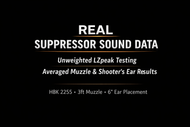
We conduct testing using an HBK 2255 impulse-capable measurement system, positioned approximately:
-
3 feet to the left of the muzzle, and
-
6 inches to the right of the shooter’s ear
This microphone placement is consistent with established industry impulse testing practices and allows for meaningful, repeatable measurement at both the muzzle and the shooter’s position.
We publish averaged LZpeak data from 3–5 shots, not the lowest single value recorded. Individual shots may meter below the published figure, but we intentionally report the average to reflect repeatable, real-world performance rather than a best-case or outlier result.
Why Measurement Method Matters
Suppressor performance is fundamentally about managing a high-pressure gas event. Internal geometry, expansion volume, pressure staging, and gas path timing all influence how effectively the impulse is shaped before it exits the muzzle and before it reaches the shooter.
When sound is measured using unfiltered peak impulse methodology, engineering effectiveness becomes clearer. Because LZpeak does not apply frequency filtering or time averaging, it reflects the true peak pressure generated during firing. Designs that appear similar under filtered or averaged metrics may perform differently when evaluated under unweighted peak impulse measurement.
In some cases, suppressor product listings may display a single decibel reduction number without additional context. Without information about the firearm platform, barrel length, ammunition used, microphone placement, shot averaging protocol, or weighting method (A, C, or Z), that number is difficult to interpret or compare. Sound performance can vary significantly based on host configuration and measurement standards. For meaningful comparison, the test conditions and methodology should be clearly defined alongside the reported decibel value.
For this reason, we publish:
-
Unweighted LZpeak impulse data
-
Both muzzle and shooter’s-ear measurements
-
Averaged multi-shot results
-
Clearly defined microphone placement and instrumentation
These values may appear higher than A-weighted or averaged figures published elsewhere, but they represent transparent, directly comparable peak impulse measurements.
Our Commitment
We are committed to full transparency in our testing and to building suppressors grounded in engineering, measurable performance, and repeatable data. Our goal is not to publish the lowest possible number — it is to provide clear, technically accurate information so customers can make informed comparisons based on consistent methodology.
We build high-quality suppressors based on engineering and data — not hype, filtered metrics, or over-sensationalized marketing. When comparing suppressors, ensure the same weighting method, microphone placement, and shot averaging protocol are being used. True unweighted peak impulse data provides the clearest view of real-world suppressor performance.